
What does “abandonment” mean?
Abandonment? Wait…what?
You might have heard recently that Norfolk Southern has filed to abandon the unused rail line from Broadway to Front Royal.
What does this mean?
“Abandonment” means something different from, say, an abandoned building. In this context, abandonment is a formal federal regulatory process that officially relieves a railroad company of its obligation to maintain a line and provide freight service. It’s also where railbanking comes in to save the day (and the corridor), but more about that in a moment.
First, let’s remember:
→ For more than 20 years, rail service in the corridor declined as shippers disappeared and rail shipping became unprofitable.
→ State and local governments tried to maintain rail operations to no avail, and service along the final segment ended in 2020 following the loss of the last shipper.
→ In the meantime, the rail infrastructure deteriorated, with ties and tracks becoming decayed and overgrown. VDOT’s assessment completed last fall found that restoring rail service would mean completely rebuilding a third of the rail line and constructing 16 new bridges at an enormous cost.
(Read the full detailed timeline here.)
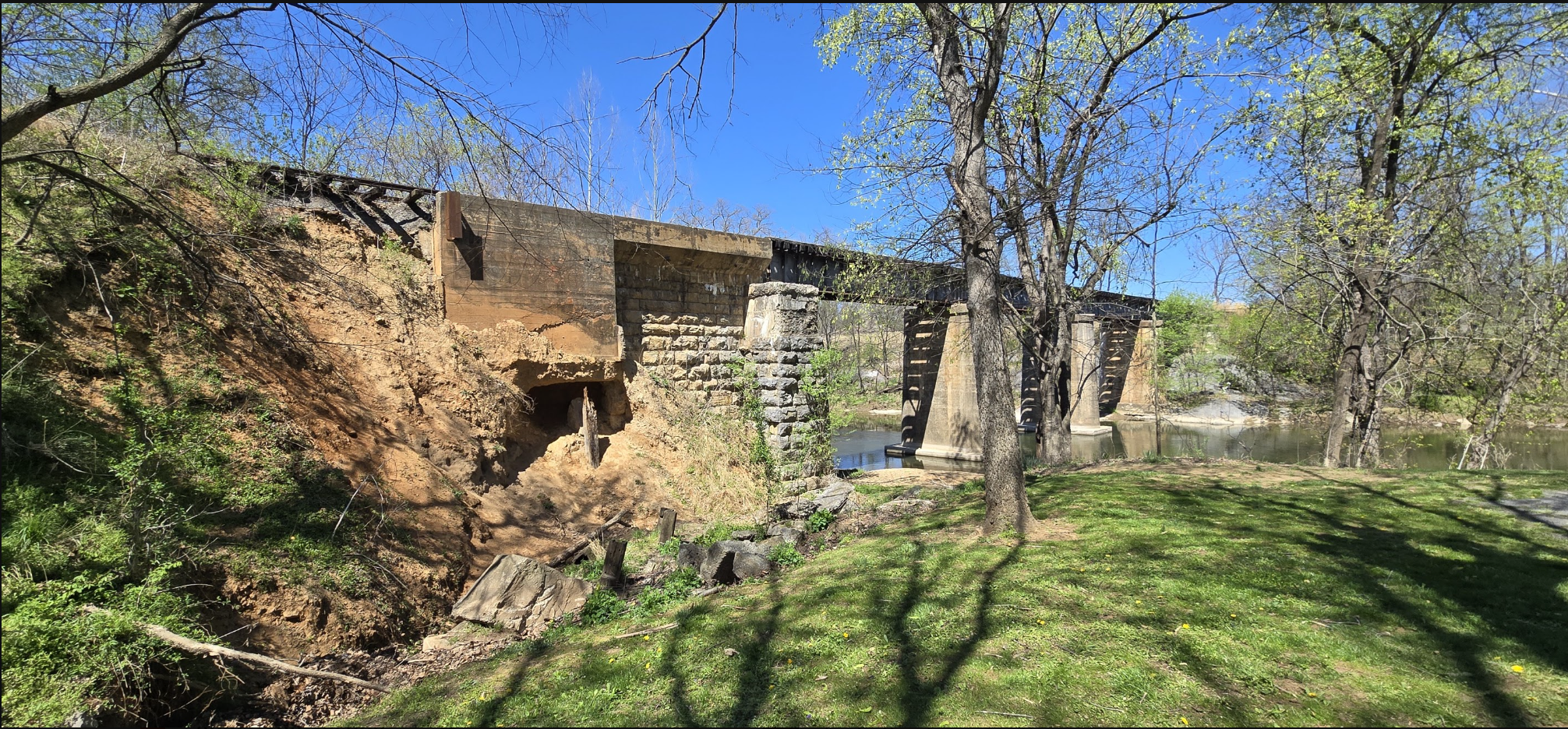
Deteriorating bridge infrastructure at Plains District Memorial Park in Timberville.
On August 19, Norfolk Southern informed a variety of federal, state, and local agencies that it is preparing to seek abandonment of the entire 48.5-mile corridor. The railway noted that it is exploring opportunities to sell the corridor, stating that it may be “available for redeployment for alternative public use(s).”
Then, on October 6, Norfolk Southern officially filed for abandonment
Here’s the “but”… Without intervention, abandonment can fracture the corridor as the land underlying the right-of-way is no longer preserved. No one wants that.
So after the abandonment request is filed – but before it is finalized – there’s an important step: a process called railbanking that ensures the corridor is preserved intact for interim public use as a trail while preserving the right-of-way for freight use when it becomes viable again in the future.
So essentially, we’re excited that the abandonment process has started, so that it can be halted through railbanking.
…Simple, right? 😅
Here’s what you can expect to see as this process moves forward:
📅 October 6: Norfolk Southern files for abandonment with the federal Surface Transportation Board (STB).
📅 Within 30 days: The organization or government agency interested in developing a trail along the disused corridor files a request for a Notice of Interim Trail Use (NITU) with the Surface Transportation Board and Norfolk Southern's legal team.
📅 10 days after that: Railbanking process begins!
We’re at the beginning of an exciting (and complicated!) time for the Shenandoah Rail Trail. We’ll keep you updated along the way. If you want to dig in more on these terms and the abandonment-railbanking-trail use process, we’ve compiled some updated FAQs here, including resources from our friends at the Rails-to-Trails Conservancy.